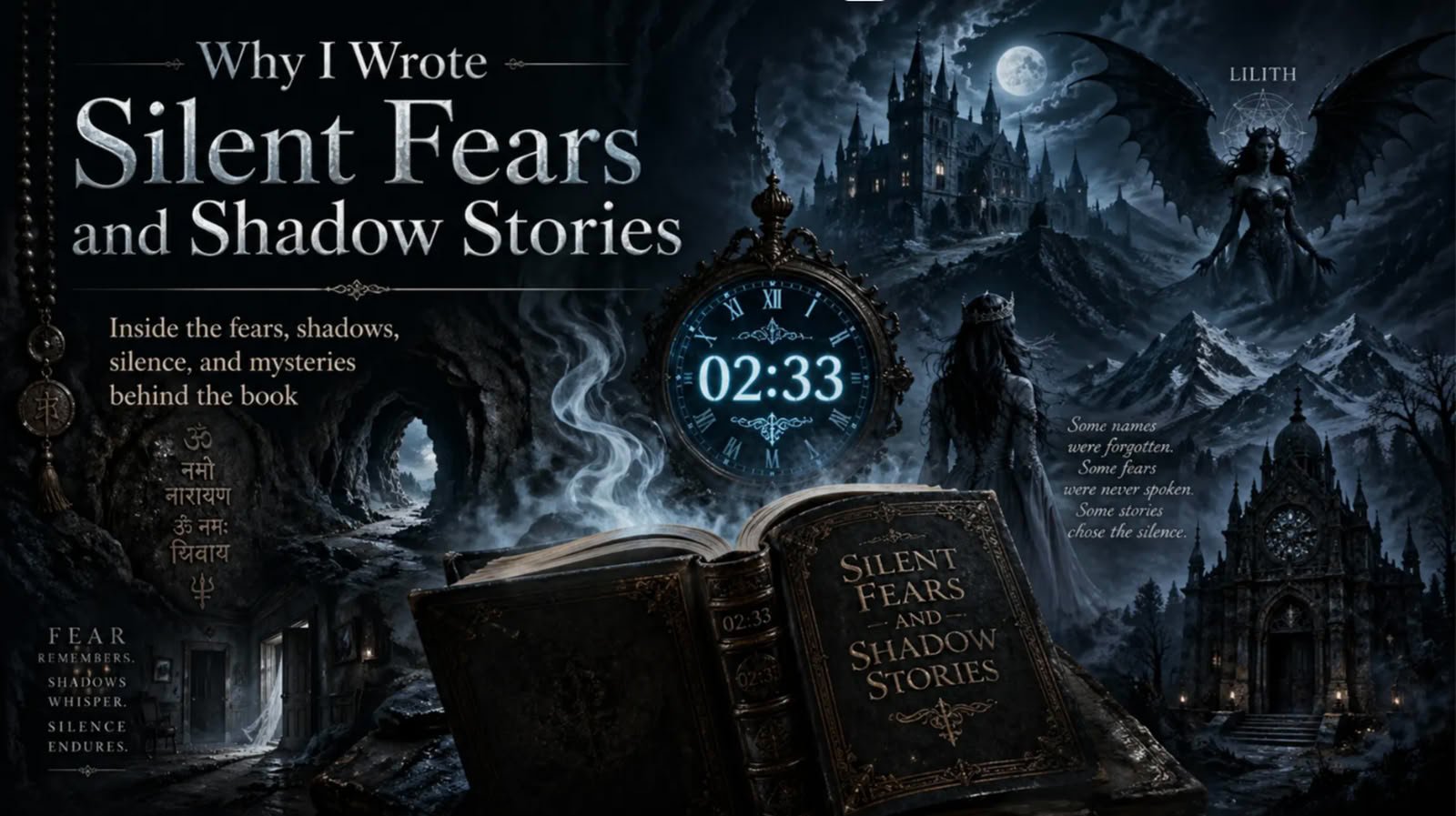
Why I Wrote Silent Fears and Shadow Stories
I did not write Silent Fears and Shadow Stories only to scare people.Fear is part of it, of course. A book with shadows, curses, forgotten names, dead hours, old houses, mountains that listen, and whispers that return from places no one should enter cannot run away from fear. But for me, fear was never just a scream in the dark. Fear was always something deeper. It was the thing people carry quietly. It was the sentence they never say out loud. It was the memory they bury and still somehow hear at night.
When I started building this book, I wanted every story to feel like it had been waiting somewhere before I found it. I did not want simple monsters that appear, attack, and disappear. I wanted the kind of horror that feels old. The kind that does not end when the door closes. The kind that follows the reader after the page is turned.
That is why this book became more than a collection of separate stories. Each story has its own world, its own characters, and its own nightmare, but underneath all of them there is one hidden pulse. A time. A wound. A whisper.
02:33.
That hour became the secret vein of the book. It is not just a number on a clock. It is the moment when reality weakens. It is the minute when the world holds its breath and something from the other side presses its face against the glass. In some stories, 02:33 appears openly. In others, it hides beneath the atmosphere. But it is always there, waiting like a door that does not fully close.
For me, Silent Fears and Shadow Stories is about what happens when silence becomes alive.
In “The Chain of Prayers,” I wanted to begin with a fear that belongs to old villages, old beliefs, and old mistakes. The village of Aynalık lives under the shadow of Mount Karaltı, where the people believe a monster sleeps inside the cave. But the truth is more painful than that. The creature is not simply a beast. It is someone who was erased. Someone whose name was taken away. Someone who was turned into a curse because people were afraid.
That story is important to me because it carries one of the strongest ideas in the book: sometimes the real monster is not the thing in the cave. Sometimes the real monster is the tradition that everyone obeys without questioning. Aras refuses to accept the sacrifice of innocent blood. Mira understands that the so-called prayers are not holy words but wounds carved into stone. Dara follows the signs that others ignore. And Selis, the forgotten princess, becomes more than a victim. She becomes a name returned to the world.
I love that idea deeply: a name can save a soul.
There is something very human in that. We all want to be remembered correctly. We all want someone to say our name in a way that brings us back to ourselves. Selis was chained by fear, but she was freed by being recognized. That is why this story is not only fantasy or horror to me. It is about identity. It is about breaking the chain that others built around your life.
Then the book moves into a much darker and more ancient place with “The First Curse: Children of Lilith” and “The First Curse II: Armageddon — The Blood of Alpha.” These stories are larger in scale. They step into myth, religion, rebellion, bloodlines, angels, vampires, wolves, and the first wound of equality. I did not want to write Lilith as a simple evil figure. I wanted her to carry pain, pride, motherhood, exile, and memory all at once.
In this world, Lilith is not only a symbol of darkness. She is the first voice that refuses to kneel. Her punishment becomes a birth. Her children become divided into blood and fang, vampires and wolves, memory and instinct. Their war is not just a supernatural war. It is a family wound stretched across centuries.
The Alpha Twelve are born from that wound. They are not ordinary creatures. They are directions, forces, fragments of an ancient order that was never accepted by heaven or earth. And when 02:33 appears in their story, it becomes a gate. Time stops. The Moon and Sun cross into the same impossible breath. The old war wakes up again.
What interested me most in these Lilith stories was not just the violence of Armageddon. It was the question behind it: who gets to write the law of the world? Who decides what is holy, what is cursed, what must be remembered, and what must be erased?
Lucifer, Michael, Lilith, the Twelve, the Broken Ones, humans caught in the middle — none of them exist in a simple black-and-white place. That was important to me. I do not like stories where darkness means evil and light means goodness without question. Sometimes light can command. Sometimes darkness can remember. Sometimes rebellion is not born from hatred, but from being forgotten for too long.
The book then shifts into a more gothic and intimate horror with “Guest Room.” This story has a different kind of fear. There is no battlefield, no army, no divine conflict. There is a boardinghouse, a writer, an old woman, a maid, a mirror, a notebook, and a room that moves things back into place.
Edward Hale comes to Whitby Boardinghouse thinking he is looking for silence. But the house gives him something else. It gives him waiting. It gives him the truth that he has already crossed a line he does not understand. I wanted this story to feel like a slow walk through a hallway where every door knows more than the person opening it.
The phrase “the house has its own order” matters a lot. It sounds polite at first. Almost harmless. But with every chapter, it becomes heavier. The house is not chaotic. It is not simply haunted. It works by rules. It counts days. It remembers names. It receives people who are between one state and another. Edward slowly learns that he is not only a guest in a room. He is a guest between life and whatever waits after it.
For me, that is one of the quietest fears in the book: not dying, but realizing you have already left and no one told you.
The house does not scream. It does not chase. It rearranges. It waits. It writes. And at 02:33, it chooses its author.
I wanted “Guest Room” to show that horror can live inside politeness. Inside a lamp being adjusted. Inside fresh sheets. Inside a mirror that feels warm like skin. Sometimes the most terrifying place is not a graveyard. Sometimes it is a room prepared perfectly for you.
Another major story in the book, “The Seventh Temple: The Messiah of Darkness,” moves into post-war Berlin. This one is built from ruins, faith, science, and the terrible arrogance of people who believe they can manufacture salvation. The Order of the New Light builds the Seventh Temple as both cathedral and laboratory. They do not pray in the old way. They create a new god from machinery, death, and human suffering.
Anna Weiss stands at the center of that story. She is not a warrior in the usual sense. She is not powerful because she has a sword or an army. Her strength comes from love, memory, and refusal. She understands that what they are creating is not light. It is hunger wearing the language of faith.
This story was my way of touching a very human danger: when people are broken by war, they often become desperate for meaning. And desperate people can be convinced that horror is holy if it is dressed in the right words. “Lux ex Tenebris” — light born from darkness — sounds beautiful, but in the wrong hands, even beautiful words become knives.
Anna’s mother’s notes matter in that story: justice is patient, fear is a false prophet, only love extinguishes fire. I wanted those words to feel small compared to the temple, small compared to the creature, small compared to the machinery. But small does not mean weak. Sometimes a single human sentence is stronger than an entire system built on fear.
That is something I believe across the whole book. Fear builds temples, chains, armies, rooms, rituals, and machines. But memory, love, and names can still break through.
There are also stories in the book that move into colder, more physical terror, like the mountain expedition where Liam, Maya, Ben, and Kaelen face the bone-white silence of the storm. I wanted that story to feel almost empty, because the emptiness is the monster. Snow, wind, altitude, madness, footprints that stop where no human body could vanish — everything becomes part of the same trap.
What I like about that kind of horror is that nature itself stops being neutral. The mountain is not just a place. It becomes aware. It separates the group. It drinks warmth, life, and eventually reason. Kaelen turns to ash. Maya breaks under what she sees. Liam survives, but survival does not mean freedom. He brings the silence back with him.
That is a cruel idea, but it is honest for horror. Sometimes the survivor is not the lucky one. Sometimes the survivor becomes the messenger. The wound walks away wearing a human body.
In another part of the book, the horror becomes modern and technological. Frequencies, screens, corporate logos, city lights, mirrors, broadcasts — these are not ancient caves or temples, but they still become vessels for something old. I wanted to show that the shadows do not disappear because humanity invents electricity. They only learn new ways to travel.
A whisper once moved through caves, prayers, and blood. Now it can move through pixels, cables, monitors, audio signals, and the glow of a screen at night. That scares me more than a traditional ghost, because it feels closer to us. We live surrounded by signals. We stare into glass all day. We trust screens with our memories, our faces, our names. So what happens if something ancient learns to speak that language?
That is why the final story, “02:33 — The Guardian of Echo,” is so important. Kaan is not just another character. He is a man destroyed by loss, trying to make sense of the impossible disappearance of his daughter, Elara. His apartment becomes an archive of pain: maps, recordings, reports, files, red strings, all pointing toward one impossible minute.
He hunts time because time took something from him.
Through Kaan, the book begins to reveal itself as one connected universe. The bridge recording, the Baltimore ritual murders, the Siberian expedition, the old monastery, the whispers, the files — everything begins to form a pattern. The separate nightmares were never fully separate. They were echoes. They were fragments of one larger wound.
That was always the structure I wanted. I wanted the reader to reach the end and feel that the book had been quietly building a hidden corridor beneath every story. You walk through different rooms: a cave, a valley, a city, a boardinghouse, a mountain, a temple, a monastery, a screen. But underneath all of them, the same hour is waiting.
02:33 is the book’s heartbeat.
For me, this book is also about silence. Not peaceful silence. Not rest. A dangerous silence. The kind that grows when truth is buried. The kind that follows injustice. The kind that fills a room after someone says nothing when they should have spoken.
In “The Chain of Prayers,” silence hides the truth of Selis. In the Lilith stories, silence hides the first wound of equality. In “Guest Room,” silence becomes the language of the house. In the mountain story, silence becomes a predator. In the monastery story, silence becomes hunger beneath the earth. In the final story, silence becomes an archive.
I think every horror story needs a question. Mine is this: what happens to the things we refuse to remember?
My answer is simple.
They wait.
They wait in caves, in names, in blood, in old rooms, in snow, in temples, in files, in screens, in clocks. They wait until the right hour. They wait until someone listens. And when they return, they do not return as they were. They return changed by the darkness we left them in.
That is why I did not want this book to be only about fear. I wanted it to be about the cost of forgetting. The cost of obedience. The cost of turning people into legends so we do not have to admit what was done to them. The cost of calling something a monster because the truth is too painful.
Many of the so-called monsters in this book are not born evil. They are made. Selis is made into a monster by fear. Lilith is made into a curse by exile. The creature in the Seventh Temple is made by human arrogance. The house in “Guest Room” becomes terrifying because it does what people cannot do: it remembers the ones who cannot return. Even the mountain, in its own strange way, is not only killing; it is preserving a silence older than the people who climb it.
I wrote these stories because I wanted the shadows to have memory.
I wanted readers to feel that every dark corner in the book contains a history. Not just danger, but history. A reason. A wound. A name.
The title Silent Fears and Shadow Stories came from that feeling. These are not loud fears. They do not always arrive with thunder. Some of them sit quietly beside you. Some of them look like grief. Some look like faith. Some look like tradition. Some look like science. Some look like a room prepared for a guest. Some look like a clock frozen at 02:33.
And shadow stories are not only stories that happen in darkness. They are stories that live behind the visible world. Behind the official report. Behind the religious explanation. Behind the family legend. Behind the police file. Behind the old myth everyone thinks they already understand.
I wanted to write from that hidden place.
If readers come to this book looking for simple answers, I do not think they will find them. But if they come looking for atmosphere, mystery, old pain, supernatural dread, and a universe tied together by whispers, then I believe they will understand what I was trying to build.
I wanted each story to leave a mark. Maybe not the same mark on every reader. Some may remember Selis and the return of her name. Some may remember Lilith and the law of equality written through darkness. Some may remember Edward Hale sitting in the waiting room. Some may remember Anna standing against the false messiah of darkness. Some may remember the mountain and its bone-white silence. Some may remember Kaan and his desperate search for Elara.
But I hope everyone remembers 02:33.
Because in this book, 02:33 is the moment when the hidden world touches ours. It is the crack in the wall. The breath under the door. The number that looks harmless until it appears again. And again. And again.
I do not want the reader to close the book and simply say, “That was scary.” I want them to close it and listen to the room around them. I want them to notice the quiet. I want them to wonder whether silence is truly empty. I want them to look at the clock one night, see 02:33, and feel for one second that the stories are not completely finished.
Because maybe they are not.
Maybe some doors in this book were never meant to close.
Maybe some names, once spoken, continue to echo.
And maybe the shadows remember far more than we do.